The Modernization Gap: Why Execution Discipline Decides IT Infrastructure Success In 2026
IT infrastructure modernization fails when cloud migrations, network upgrades, and data platform overhauls are treated as disconnected projects instead of a single, governed transformation program. The deciding factor is not which cloud…
For most mid‑market enterprises, infrastructure modernization has moved from a slide in the IT strategy deck to a survival question. The board sees competitors shipping new digital features, spinning up new business models, and closing the books faster, while internal teams are still nursing decade‑old servers and a patchwork of firewalls that nobody wants to touch.
In the server rooms and cloud consoles of these organizations, the real story looks familiar. A core ERP is still running on aging hardware. The WAN is held together by a mix of MPLS and point solution SD‑WAN appliances. Identity is split across multiple domains. Cloud workloads have grown organically without a clear landing zone design. Everyone agrees modernization is urgent, but nobody can quite answer the practical question: what exactly do we modernize, in what order, and how do we avoid breaking the business in the process?
The modernization gap, the distance between how your infrastructure operates today and what it needs to look like to support the next five years of growth, is widening. And in 2026, that gap is no longer a technical nuisance. It is a strategic risk.
The problem is not that IT leaders ignore modernization. The problem is that modernization is often framed as a technology shopping list instead of a governed, staged program that connects infrastructure decisions directly to business outcomes. The solution is not another round of tools. It is a modernization playbook that brings the same rigor to infrastructure that the best organizations already apply to finance, sales operations, and M&A.
What Is The Hidden Risk That Derails IT Infrastructure Modernization?
Technical debt and operational fragility are the hidden risks that undermine modernization efforts. Every organization accumulates technical debt. Old switches and firewalls that nobody wants to reboot. Custom scripts that only one engineer understands. Legacy backup systems that work just well enough to stay off the radar. Over time, these choices become constraints that shape what is even possible.
When you finally launch a modernization program, that technical debt does not simply disappear. It shows up as unplanned work, extended outages, and projects that stall halfway because a critical dependency was not discovered until the change window.
For a mid‑market enterprise doing 10 to 100 million dollars in revenue, the impact is rarely an eye‑catching headline. It looks like this instead:
- Run cost that refuses to go down: hardware support contracts, overlapping tools, and data center leases that consume budget you thought cloud savings would free up
- Change windows that never close on time: simple firewall changes that cascade into routing issues, identity problems, and late‑night rollback calls
- Security exposure: inconsistent patching, legacy VPN concentrators, and access models that make zero trust more slogan than reality
- Resilience gaps: DR plans that exist in documentation but have not been tested end‑to‑end in years
- Talent frustration: senior engineers spending 70 percent of their time keeping the lights on instead of building the future
Infrastructure modernization fails, not because the target architecture is flawed, but because organizations underestimate how much of this embedded risk needs to be surfaced and managed before the first migration wave even starts.
Where Infrastructure Fragmentation Creates Value Leakage
Infrastructure fragmentation is not just an architectural aesthetic problem. It is where value quietly leaks out of the business. The same dynamic appears after a divestiture, where stranded infrastructure cost sits on the seller’s books long after close. We cover that case in our guide to IT TSA exit planning and stranded cost control.
- Duplicate platforms and tools: multiple monitoring systems, overlapping security tools, and separate storage platforms kept alive because nobody owns the consolidation decision
- Inconsistent standards: different regions or business units running their own naming conventions, VLAN schemes, cloud resource patterns, and backup policies
- Shadow infrastructure: labs and side projects that have become production critical but still sit under personal accounts or unmanaged clusters
- Data gravity issues: analytics workloads forced to traverse expensive links or slow connections because data remains trapped in older environments
- Manual workarounds: network and system engineers building one‑off solutions to bridge old and new, creating more dependencies with each ticket
In this environment, even a well designed cloud or network blueprint can underperform. The business case that promised 30 to 40 percent cost reduction and faster delivery is eroded by parallel run costs, extended coexistence of old and new platforms, and a growing portfolio of “temporary” fixes that never quite get cleaned up.
The core issue is not that modernization is technically difficult. It is that organizations attempt it as a series of isolated projects instead of a single, governed program that treats technical debt, fragmentation, and business risk as first‑class citizens.
How Does Program‑Level Modernization Governance Solve The Problem?
A modernization program office is not a PMO in name only that compiles status reports and schedules meetings. Program‑level governance for infrastructure modernization means a central function that owns the modernization roadmap, manages cross‑domain dependencies, enforces architectural standards, and protects the business from unmanaged risk.
In practice, this governance function is the difference between a collection of well intentioned upgrades and a coherent infrastructure evolution.
Here is what program‑level modernization governance does that changes outcomes for mid‑market enterprises.
Strategy Stage: Turning Modernization From Wish List To Roadmap
The first step is to translate modernization from a sentence in the strategy deck into a set of measurable, sequenced objectives.
A well structured modernization program does not start with “move everything to cloud” or “refresh all switches.” It starts with questions:
- Which business capabilities are currently constrained by infrastructure? Examples include month‑end close, e‑commerce peak handling, remote work experience, or integration of acquired entities.
- What are the top five risks we are accepting today by staying on the current stack? Think aging core switches, unsupported hypervisors, or single‑region cloud designs.
- What is the financial ambition of modernization? Run cost reduction targets, data center exit timelines, or capital to operating expense shifts.
Those answers drive a modernization blueprint that does three things:
- Defines the target state across network, compute, storage, identity, security, and observability.
- Identifies the critical path that must be modernized first to unlock value and reduce risk.
- Sequences work into phases that are achievable with the resources and change windows the business can realistically support.
This blueprint becomes the reference point for every vendor conversation, every project proposal, and every change advisory meeting that touches infrastructure.
Design Stage: Building A Target Architecture You Can Actually Operate
Many organizations have an impressive set of reference diagrams that show what the future could look like. The hard question is whether that target state can be operated by the team you have today, with the processes you can realistically put in place over the next one to two years.
Program‑level governance forces a pragmatic design conversation:
- Do we have clear landing zones for cloud workloads with identity, networking, security, and guardrails baked in?
- Is the network design simple enough that a new engineer can understand core flows without days of handholding?
- Is our observability stack capable of giving a single view of health across old and new environments during transition?
- Are resilience patterns consistent, or are we maintaining different DR strategies for each platform?
The goal is not perfection. It is a target design that is:
- Secure by default
- Automatable where it matters
- Operable by the current and near‑term team
- Flexible enough to support the next three to five years of product strategy
Execution Stage: Governing The Critical Path
Once modernization work starts, the daily reality looks less like architecture diagrams and more like change tickets, maintenance windows, and business stakeholders asking, “Will this impact our customers?”
Execution governance keeps modernization on track by:
- Owning a single modernization master plan that integrates all infrastructure, application, and security workstreams
- Managing dependencies between projects, so that a firewall replacement does not block a cloud cutover, and a storage migration does not derail a DR test
- Running a decision cadence that escalates conflicts early and prevents stack‑rank debates from stalling entire waves
- Maintaining a risk register that is more than a compliance artifact, with clear owners and mitigation plans for each high impact risk
In this model, RAG status is not the point. The value lies in catching issues while there is still time to change course and in forcing trade‑off conversations when there is still room to make considered decisions, rather than reacting in the middle of a failed change window.
Long Term: Using Modernization To Reduce Technical Debt Instead Of Shuffling It Around
The best modernization programs do not just “lift and shift” technical debt from the data center to the cloud or from one vendor’s hardware to another. They use modernization as an inflection point to fundamentally reduce the complexity of the infrastructure estate.
That looks like:
- Consolidating overlapping tools and platforms instead of translating all of them into the new environment
- Removing unsupported operating systems and middleware as part of migration waves instead of postponing upgrades indefinitely
- Simplifying network and security policies through consistent segmentation and identity‑driven access
- Standardizing patterns for new workloads so that the next acquisition, product launch, or region can be added without bespoke design work
Without this discipline, organizations can find themselves three years into modernization with new cloud platforms, a new SD‑WAN, and the same or greater level of technical debt.
Program‑Led vs Ad Hoc Infrastructure Modernization: What Is The Difference?
The contrast between organizations that treat infrastructure modernization as a governed program and those that approach it as a set of ad hoc projects is stark. The following comparison illustrates the difference across critical dimensions.
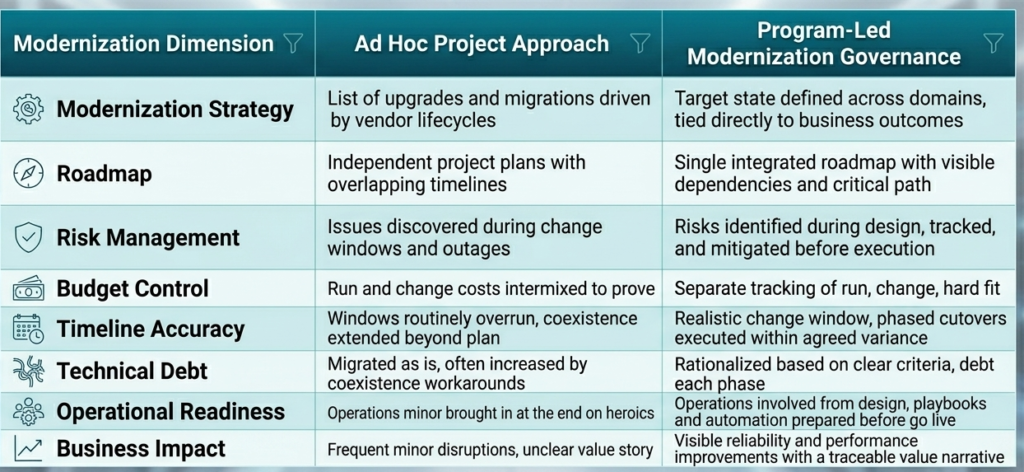
For mid‑market organizations, the difference between these two approaches is often the difference between a modernization story that earns more investment and one that quietly loses sponsorship after the first wave.
What Does An IT Infrastructure Modernization Playbook Look Like In Practice?
A structured modernization playbook, governed as a program, follows a phased approach that aligns infrastructure work with business priorities and realistic capacity.
While every organization’s estate and constraints are unique, the pattern is consistent.
- Phase 1: Assessment And Prioritization. Build a current state map of infrastructure assets, technical debt, and risk. Identify the top business capabilities constrained by infrastructure. Develop a target state view and define modernization themes for the next 18 to 36 months.
- Phase 2: Foundation And Quick Wins. Establish core patterns such as cloud landing zones, modern identity foundations, and baseline observability. Execute a small number of visible quick wins that retire high risk assets or remove obvious pain points for the business.
- Phase 3: Core Platform Modernization. Tackle high impact domains such as data center exit, network core refresh, SD‑WAN rollout, primary storage transformation, or primary cloud migration waves. Govern cutovers tightly, with clear rollback plans and post‑implementation reviews that actually drive learning.
- Phase 4: Optimization And Debt Reduction. Focus on consolidating tools, simplifying configurations, and retiring redundant platforms. Embed automation where it creates measurable value in operations.
- Phase 5: Continuous Evolution. Shift from project‑mode modernization to a capability that continuously adapts infrastructure to new business needs, with an explicit backlog, budget, and governance cadence.
This playbook does not remove the complexity of modernization. It contains it. Instead of a series of one‑off hero efforts, modernization becomes a predictable, transparent part of how the organization evolves its technology foundation.
Frequently Asked Questions About IT Infrastructure Modernization In 2026
Why do most IT infrastructure modernization efforts underperform?
Most modernization efforts underperform because they are framed as technology upgrades, not as a governed program aligned to business outcomes. Organizations underestimate the amount of technical debt that has to be addressed, lack an integrated roadmap across domains, and do not invest in the operational readiness required to run the new environment reliably.
How should mid‑market IT leaders prioritize what to modernize first?
Start with business impact and risk. Identify the top three to five business capabilities constrained by infrastructure and the top risks created by aging platforms or architectures. Modernize where those two lists intersect. Resist the urge to start with the most interesting new technology. Start where modernization reduces risk or unlocks measurable value.
How long does a realistic modernization program take?
For a mid‑market organization, a pragmatic modernization program spans 18 to 36 months. The first six to nine months are typically focused on assessment, blueprinting, and foundational changes. The following 12 to 24 months handle core migrations, network and security evolution, and systematic reduction of technical debt. Attempts to compress this into a single year usually result in extended coexistence and unfinished work.
What skills are critical for a successful modernization program?
Beyond domain expertise in networking, cloud, security, and data platforms, successful modernization programs require program leadership that understands both infrastructure and business context. Change management, communication, and the ability to make and explain trade‑offs are as important as technical depth. Without these skills, even well designed architectures fail to gain and keep support.
How should modernization success be measured?
Measure success across three dimensions. First, reliability and risk, including incident rates, recovery times, and elimination of known high risk assets. Second, financial impact, including run cost trends, data center exit milestones, and tool consolidation benefits. Third, business enablement, such as faster time to deliver new environments, smoother integration of acquisitions, and improved experience for remote and frontline workers.
Closing The Modernization Gap: From Technical Chore To Strategic Advantage
The modernization gap is now a core strategic issue for IT leaders. It is the space between what your infrastructure can support today and what your business will demand over the next few years. Leaving that gap unmanaged means accepting more outages, more constraints on growth, and more talent frustration.
The difference between organizations that use modernization to create advantage and those that simply shift technical debt from one platform to another is not a matter of better vendors. It is a matter of better program discipline.
When IT infrastructure modernization is governed as a program of record, anchored in business outcomes, and executed through a clear playbook, it stops being a series of risky projects and becomes a repeatable capability.
For IT directors, senior infrastructure leaders, and PMO heads in mid‑market enterprises, the message is straightforward. Treat modernization as seriously as you treat your core revenue systems and strategic initiatives. The infrastructure you modernize over the next 18 to 36 months will determine not only how reliably your business operates, but how quickly it can move when the next opportunity, acquisition, or disruption arrives.