
Digital transformation has evolved from a “nice-to-have” initiative to a business imperative. 94% of enterprises are allocating significant budgets to digital technology investment in the next 18 months, yet 47% of digital transformations underperform expectations. The difference between success and failure typically hinges not on technology choice, but on strategy execution, organizational alignment, and disciplined change management.
This comprehensive guide covers the proven five-pillar framework that successful enterprise transformations follow—from initial strategic planning through continuous optimization. Whether you’re modernizing legacy infrastructure, implementing AI and automation, or fundamentally reimagining business models, this guide provides the strategic clarity and actionable frameworks enterprise leaders need to deliver measurable results.
The Digital Transformation Imperative: Why Your Organization Needs This Now
Market Urgency and Competitive Pressure
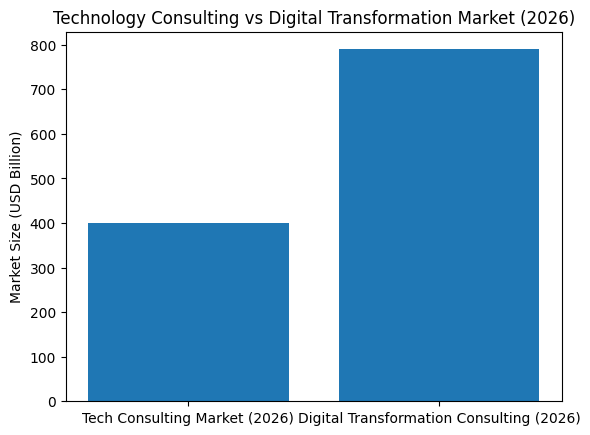
The technology consulting market has reached an inflection point. The global tech consulting market is projected to surpass $400 billion in 2026, growing at 7% annually. Digital transformation consulting specifically represents a $789.9 billion market in 2026, growing at 14.1% CAGR—indicating unprecedented demand from enterprises recognizing transformation as business-critical.
Why the urgency? Three converging forces:
- Competitive Threat from Digital Leaders
Digital leaders—organizations that have successfully transformed—are gaining 2-3x operational advantage over peers. These advantages compound: faster time-to-market attracts better talent, better talent drives innovation, innovation creates competitive moat. Digital laggards face existential risk within 3-5 years. - Cost Pressures from Aging Infrastructure
Legacy systems consume disproportionate IT budgets. Outdated infrastructure consumes 60-70% of IT spending at mature enterprises, leaving minimal budget for innovation. Technical debt becomes strategic liability. Modernization isn’t optional—it’s survival. - Customer Experience Expectations
Digital-native competitors have set new expectations. Customers expect frictionless omnichannel experiences, personalized interactions, and real-time responsiveness. Organizations stuck on legacy systems cannot compete.
The Three Business Drivers of Transformation
Successful transformations are driven by one or more of these business outcomes:
Cost Reduction Through Modernization
- Cloud platforms reduce infrastructure costs by 30-50% vs. on-premise
- Automation eliminates manual processes, reducing labor costs
- Legacy system decommissioning reduces licensing, maintenance, support costs
- Real-world example: A financial services firm reduced infrastructure costs by 40% through cloud migration and operational optimization
Revenue Generation Via New Experiences
- Digital platforms enable new customer channels (e.g., mobile, web, API-based partners)
- Real-time data enables personalization, increasing customer lifetime value
- Faster time-to-market from agile technology stack enables competitive advantage
- Real-world example: A retail organization increased online sales by 65% through omnichannel platform modernization
Risk Mitigation (Cybersecurity, Compliance, Technical Debt)
- Modern architecture incorporates security-by-design vs. bolted-on security
- Cloud platforms provide compliance-ready infrastructure (SOC2, HIPAA, PCI, etc.)
- Reduced legacy system exposure decreases security breach risk
- Real-world example: A healthcare provider achieved HIPAA compliance 18 months faster through cloud-native architecture
Market Context: Enterprise Spending and Consulting Demand
84% of enterprises are planning technology upgrades in the next 12 months. Critically, 81% of enterprise IT leaders plan to increase consulting reliance to manage transformation complexity. This isn’t because enterprises lack smart people—it’s because transformation requires specialized expertise, objective perspective, and proven methodologies that internal teams rarely possess.
The transformation opportunity is massive. The risk of failure is equally massive: 50% of digital transformations fail to deliver expected business value, primarily due to strategy misalignment, inadequate change management, and unrealistic timelines.
The Five Pillars of Successful Enterprise Transformation
Successful digital transformations share a common architecture across companies, industries, and geographies. These five pillars dramatically increase success probability.
Pillar 1: Strategic Alignment — Let Business Goals Lead Technology
Most digital transformations fail not because of poor technology, but because technology is chosen before the business problem is clearly defined.
Organizations often start with statements like “We need cloud,” “We need AI,” or “We need a new app.” These are solutions, not strategies. When technology decisions are made in isolation, costs increase, complexity grows, and business impact remains limited.
Successful enterprise transformations reverse this approach. They start with business outcomes, and only then decide what technology is required. Technology becomes an enabler — not the driver.
What Strategic Alignment Looks Like in Practice
- Business capabilities come first
Define what the business must be able to do to compete—such as real-time order fulfillment, fraud detection, personalized customer experiences, or supply chain visibility. These are outcomes, not tools. - Technology is mapped to outcomes
Existing systems are evaluated based on how well they support these capabilities. Gaps reveal where legacy systems limit growth and where transformation will deliver real value. - Roadmaps are driven by business impact
Technology investments are sequenced by measurable business results, not technical upgrades. Success is tracked using business KPIs, not system metrics.
A simple way to measure this is the Alignment Index—the percentage of IT initiatives directly tied to business KPIs. High-performing organizations maintain this above 85%. Anything below 60% signals a technology-first mindset and wasted investment.
Key takeaway: Strategic alignment is the foundation of successful enterprise transformation. When business outcomes lead technology decisions, transformation delivers ROI. When they don’t, even the best technology fails to move the business forward.
Pillar 2: Organizational Change Management — Focus on People and Process, Not Just Technology
Digital transformation rarely fails because of technology.
It fails because people are not ready to change.
In fact, nearly half of transformation failures are driven by poor change management — not system issues. Organizations that spend most of their budget on tools and platforms, while underinvesting in people and process, consistently underperform. High-performing enterprises take a balanced approach, investing just as much in change management as they do in technology.
Why Change Management Matters So Much
Transformation forces employees to rethink how they work every day. They are asked to learn new systems, adopt new workflows, collaborate differently, and accept new measures of success — all while still delivering results. This is not a technical shift; it is a behavioral and psychological change.
Without structured change management, organizations typically experience:
- Low user adoption and reliance on old processes
- Longer time-to-value as teams resist or delay change
- Increased staff turnover, especially among high performers
- Project delays caused by fatigue and uncertainty
Strong change management directly addresses these risks.
What Effective Change Management Looks Like
- Stakeholder-centric planning
Different groups experience change differently. Executives face accountability pressure, managers fear loss of control, and individual contributors worry about daily workflow and skill gaps. Understanding these impacts early allows leaders to address resistance before it escalates. - Clear and repeated communication of the “why”
Vague messages like “we need to modernize” do not motivate anyone. Employees need to understand the business reason for change — whether it is reducing costs, staying competitive, or securing future growth. This message must be repeated consistently, not communicated once and forgotten. - Visible leadership sponsorship
Transformation must be led from the top. When executives actively communicate progress, participate in steering committees, and tie incentives to outcomes, employees recognize that the change is real and permanent. - Structured support during transition
Training must begin well before go-live and continue after. Employees need time, support, champions, and feedback loops to build confidence. Celebrating early wins reinforces momentum and trust. - Skills development and career growth
Transformation creates new roles and skill demands. Organizations that invest in upskilling and clear career paths see higher adoption, stronger engagement, and better talent retention.
The ROI of Change Management
Change management is not a “soft” activity — it is one of the highest-return investments in transformation. Organizations that prioritize it achieve faster adoption, smoother transitions, and sustained business results. Those that ignore it face delays, cost overruns, and failed implementations.
Key takeaway: Technology enables transformation, but people deliver it. Enterprises that invest seriously in change management move faster, adopt better, and succeed longer.
Pillar 3: Technology Foundation — Build the Right Base Before You Scale
Technology does not create transformation by itself, but a weak foundation will break it every time.
Modern enterprises can no longer rely on rigid, monolithic systems. Today’s successful organizations build modular, cloud-enabled, data-driven technology foundations that allow them to move faster, scale efficiently, and innovate continuously.

What a Strong Technology Foundation Includes
- Flexible cloud architecture
Most enterprises adopt a hybrid or multi-cloud approach—keeping sensitive workloads on-premise while using cloud platforms for speed, scalability, and innovation. The goal is flexibility, not blind cloud migration. - Data as a core asset
A centralized data platform enables real-time visibility instead of delayed reporting. When data is integrated, governed, and accessible, organizations make faster decisions, reduce costs, and unlock advanced analytics. - Built-in security and compliance
Security can no longer be an afterthought. Modern foundations use zero-trust principles, strong data protection, and compliance-ready infrastructure to reduce risk while supporting growth. - AI and automation layers
Automation handles repetitive work, while AI improves prediction, personalization, and productivity. When layered on clean data and stable systems, AI delivers real business value—not hype. - Modern integration and operations
APIs, microservices, and automated deployment pipelines allow teams to release features faster, scale independently, and avoid bottlenecks caused by centralized control.
Why the Technology Foundation Matters
Organizations with modern foundations consistently see:
- Lower infrastructure costs
- Faster product and feature delivery
- Higher system reliability
- Better employee productivity
- Faster adoption of AI and analytics
The biggest mistake companies make is overspending on “shiny” technologies while underinvesting in core foundations like data integration, security, and governance.
Key takeaway: Technology foundation is an enabler, not the driver, of transformation. When built correctly, it quietly powers speed, scale, and innovation. When ignored, even the best strategies fail to deliver ROI.
Pillar 4: Execution Excellence — Turning Strategy into Real Results
Strong strategy means nothing without strong execution.
Many transformations fail not because the vision was wrong, but because delivery lacked discipline. Organizations with execution excellence deliver on time, stay within budget, and actually realize business benefits. Those without it face delays, cost overruns, and fading momentum.
What Execution Excellence Looks Like
- PMO-led governance and control
A strong Project Management Office ensures projects are prioritized correctly, risks are identified early, budgets are tracked closely, and teams focus on what matters most—rather than trying to do everything at once. - Phased delivery instead of big-bang launches
Successful transformations are delivered in phases. This reduces risk, allows learning along the way, creates early wins, and enables course correction as business conditions change. - Clear accountability and transparency
Progress, costs, risks, and outcomes are reviewed regularly. Funding is released based on milestones, not assumptions, keeping teams accountable and focused on delivery.
Why Phased Execution Works
Breaking transformation into phases:
- Lowers overall risk
- Builds momentum through early results
- Spreads investment over time
- Prevents large-scale failures
- Protects ROI when priorities shift
Organizations that follow this approach consistently deliver higher returns with fewer surprises.
Key takeaway: Execution excellence is not about speed alone—it is about discipline. With strong governance, phased delivery, and transparent management, transformation moves from planning to measurable impact.
Pillar 5: Continuous Optimization — Measure, Learn, and Evolve
One of the biggest mistakes organizations make is treating transformation as a project with an end date. When systems go live, many teams declare success and move on. In reality, go-live is just the beginning.
The real value of transformation is unlocked after implementation—through continuous measurement, feedback, and improvement.
What Continuous Optimization Looks Like
- Measure what truly matters
Successful organizations track business outcomes first—cost reduction, revenue impact, customer satisfaction, employee engagement, and speed to market. Operational metrics and system health support these goals, but they never replace them. - Track adoption, not just performance
If people are not using new systems or processes, transformation is failing silently. Usage rates, process adoption, and user satisfaction reveal whether change is actually sticking. - Build strong feedback loops
Regular reviews at the executive, operational, and user levels surface what is working and what needs adjustment. Continuous feedback prevents small issues from becoming long-term value leaks. - Evolve the roadmap continuously
Business priorities shift, markets change, and new technologies emerge. High-performing organizations revisit their transformation roadmap quarterly and adjust based on results, not assumptions.
Why Continuous Optimization Drives Higher ROI
Organizations that treat transformation as an ongoing discipline consistently outperform those that treat it as a one-time initiative. Over time, continuous optimization compounds value—improving adoption, increasing ROI, and keeping the organization competitive.
Key takeaway: Digital transformation is not a finish line. It is a continuous journey of measurement, learning, and evolution. Organizations that embrace this mindset realize far greater long-term value than those that stop at implementation.
Industry-Specific Digital Transformation Playbooks
Digital transformation does not follow a one-size-fits-all model. While the five pillars remain constant, every industry faces different regulations, customer expectations, and competitive pressures. This is where experienced IT consulting services add the most value—by translating universal principles into industry-relevant execution.
A strong IT consulting firm does not start with technology. It starts by understanding how your industry actually works.
Financial Services: Competing on Speed, Trust, and Experience
Banks and financial institutions operate under heavy regulation while competing with digital-first fintechs. Transformation efforts here focus on secure modernization without disrupting trust.
Common priorities include digital customer onboarding, real-time fraud detection, cloud-based core systems, and API-driven partnerships. With the right IT consulting services, financial organizations reduce transaction costs, improve customer experience, and remain compliant without slowing innovation.
Healthcare: Better Outcomes Through Smarter Systems
Healthcare transformation is driven by patient experience, interoperability, and cost control. Providers modernize EHR platforms, enable telemedicine, and use data to predict outcomes and reduce readmissions.
An experienced IT consulting firm helps healthcare organizations balance compliance with agility—ensuring technology improves care delivery rather than adding administrative burden.
Manufacturing: Visibility, Efficiency, and Resilience
Manufacturers use digital transformation to gain real-time insight across production and supply chains. IoT, predictive maintenance, and AI-driven forecasting reduce downtime, improve quality, and strengthen resilience.
Here, IT consulting services help manufacturers connect data across legacy and modern systems, turning operational insight into measurable cost savings.
How Successful Transformations Actually Happen
Successful transformations are phased, not rushed. Organizations begin with discovery and strategy, deliver early quick wins, scale proven solutions, and then continuously optimize.
A trusted IT consulting firm plays a critical role in this journey—bringing structure, governance, and experience while helping internal teams execute with confidence.
The Bottom Line
Digital transformation is not about adopting the latest technology. It is about building the right capabilities, executing with discipline, and continuously improving.
Organizations that partner with the right IT consulting services move faster, avoid common pitfalls, and achieve sustainable results. Those that delay or approach transformation without guidance often struggle to keep up.
Your transformation journey does not start with tools. It starts with clarity, commitment, and the right partner.
Gartner: “CIO Agenda 2026” (2025)